
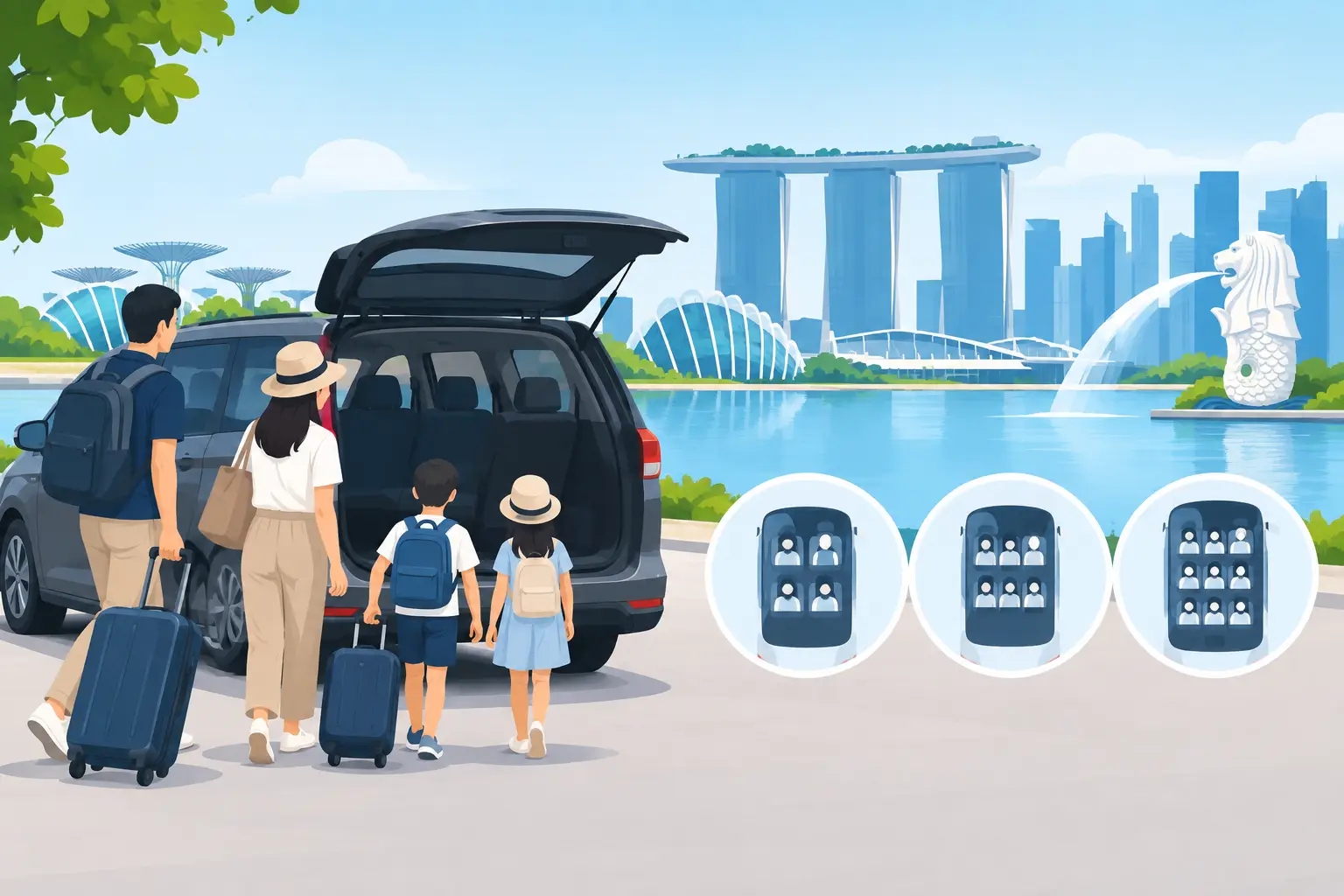
Landing at Changi with six people, four large suitcases, two cabin bags, and a stroller is not the moment to guess what will fit. Knowing how to select MPV capacity before you book helps your group leave the airport together, travel comfortably, and avoid needing a second vehicle at the last minute.
The right MPV is not simply the one with the highest advertised passenger number. A vehicle may have seven seats, for example, but the usable space changes when every traveler has checked luggage. For a smooth Singapore transfer, consider passengers, bags, children, and the length of your journey as one plan.
Start With People, Then Count Every Bag
Begin with the exact number of passengers who will be in the vehicle, including infants and children. A child may need less seat space than an adult, but they still require a proper seat position and may need a child seat. Do not count a child as a lap passenger when planning private transport.
Next, count luggage by size, not just by the number of pieces. One large checked suitcase can take the space of two or three soft bags. If your group has hard-shell suitcases, golf bags, foldable wheelchairs, strollers, or shopping boxes, mention these at the time of booking.
A practical way to estimate space is to separate bags into three groups: large checked suitcases, cabin-size bags, and small personal items such as backpacks or handbags. Large suitcases affect vehicle selection most. Cabin bags can sometimes be placed around the seating area, while small personal items are usually easy to accommodate.
For airport pickup, be especially realistic. Travelers often carry more on arrival than they expect, particularly families, cruise passengers, and guests staying for a longer holiday. If you are unsure between two vehicle sizes, choosing the roomier option is usually the more comfortable decision.
How to Select MPV Capacity Without Overcrowding
MPV capacity has two separate limits: the legal number of seated passengers and the practical amount of passenger-and-luggage space. Both matter.
An MPV advertised for six or seven passengers may work very well for a group traveling with light luggage. For example, a family of five with a few cabin bags can often travel comfortably. The same MPV may feel tight for five adults carrying five large suitcases, especially after a long flight.
Instead of asking only, “How many seats are there?” ask these questions:
- How many adults, children, and infants are traveling?
- How many large suitcases and cabin bags will you bring?
- Is anyone bringing a stroller, mobility aid, sports equipment, or oversized item?
- Do you need a child seat, booster seat, or extra room for a senior traveler?
These details let your transport provider recommend a vehicle based on real travel needs, not an optimistic seat count. A professional driver should never need to rearrange your group at the curb because the vehicle was booked too small.
Match the MPV to Your Type of Singapore Trip
The best vehicle depends on how your group will use it. An airport transfer is different from a short point-to-point ride, and a city tour has different comfort needs again.
Airport Arrival and Departure Transfers
For Changi Airport transfers, luggage is the main consideration. After collecting bags, your group may also have duty-free purchases, child equipment, or hotel supplies. Leave a margin rather than booking to the vehicle’s maximum limit.
A smaller MPV can be suitable for two to four travelers with standard luggage. A larger MPV is often the better choice for five to seven travelers, families with strollers, or guests carrying several large bags. For bigger groups, separate vehicles or a minibus may be more practical than trying to fit everyone into one MPV.
For departure transfers, remember that luggage can increase during the trip. Singapore shopping, souvenirs, and extra purchases may mean your return load is larger than your arrival load.
Family Travel
Families benefit from space that is easy to use, not merely available on paper. Parents may need room to help children enter and exit safely, keep a diaper bag nearby, or store a stroller. Grandparents may appreciate easier access and more legroom, particularly after a flight.
If your group includes young children, share their ages and child-seat requirements when booking. This gives the transport team time to arrange the right setup and select a vehicle with sensible seating space.
Corporate Travel and Small Groups
For business travelers, a comfortable MPV creates a better start to a meeting day. Colleagues often carry laptop bags, presentation materials, or event equipment in addition to luggage. If passengers need to make calls or prepare during the journey, extra room can make a noticeable difference.
Small tour groups should also consider the itinerary. A direct airport-to-hotel ride may be fine in a more compact vehicle. A half-day or full-day charter, with multiple stops and hours on the road, calls for more personal space and room for belongings.
Do Not Treat Every Seat as Equal
The final row in an MPV is useful, but it can reduce trunk space when fully occupied. This is the most common reason travelers underestimate their vehicle needs. Filling every passenger seat often means there is less room behind the last row for large suitcases.
Seating comfort can also vary. Adults may find a rear seat less comfortable on a longer journey, while children often fit there more easily. If everyone in your group is an adult, or if any traveler has limited mobility, tell the booking team rather than assuming every seat will suit every passenger.
The same applies to hand luggage. Keeping one small bag close by is convenient. Placing several cabin bags around passengers’ feet can make boarding difficult and reduce comfort, particularly in Singapore’s warm and humid weather after an outdoor stop.
Share Details Early for a Better Recommendation
Clear booking details prevent delays. When requesting an MPV, provide your pickup and drop-off locations, flight number if applicable, passenger count, and luggage count. Mention any special items in plain language. “One foldable wheelchair,” “two golf bags,” or “a double stroller” is more useful than simply writing “extra luggage.”
It also helps to say whether your bags are large, medium, or cabin-size. Photos can be useful if an item is unusually bulky. There is no need to overcomplicate the request, but accurate information helps the transport provider plan with confidence.
At RetTours, this approach supports a smoother pickup experience: the driver arrives prepared, the vehicle suits the group, and you can head to your hotel or next stop without transport stress.
When a Larger Vehicle Is the Smarter Value
A larger MPV or minibus may cost more than a compact option, but the value is not only about seat count. It can keep the group together, eliminate the need for an extra taxi, and give travelers space to relax after a flight.
Consider upgrading when your group is close to the maximum capacity, when several passengers have large bags, or when comfort matters for a longer transfer or city charter. The difference is often small compared with the inconvenience of splitting family members, managing extra vehicles, or discovering at pickup that the luggage does not fit.
For very large groups, a bus can be the more efficient choice. It simplifies coordination for tour leaders, travel agents, and corporate organizers, while giving every passenger a confirmed place and keeping the group on one schedule.
A Simple Rule for Confident Booking
Choose an MPV based on the heaviest realistic version of your trip, not the lightest possible version. Count every passenger, include every large bag, account for child seats and special items, then allow a little extra room when the vehicle will be near capacity.
A comfortable transfer sets the tone for the rest of your Singapore visit. Share your group details early, choose space over guesswork, and let the ride from airport to hotel feel as easy as it should.